We all know and have experienced how music can change a room’s vibe. A single note, a chant, or a gentle hum can shift mood, and even our heartbeat. And what if sound doesn’t just move us emotionally, but also shapes matter itself? That’s the mystery and magic of Cymatics, the study of visible sound and vibration.
The word Cymatics comes from the Greek kyma, meaning “wave.” It is the science of how sound frequencies create patterns in physical matter. When sound waves move through a medium such as water, sand, or air, they form geometric shapes. These patterns change with frequency: Lower tones create simple, wide shapes and Higher tones generate intricate, symmetrical designs, resembling sacred geometry in motion.
Swiss scientist Hans Jenny popularised Cymatics in the 1960s using a metal plate, fine powder, and sound vibrations. He demonstrated that every frequency has form, a visible signature of vibration. Ancient cultures already knew what modern science is rediscovering: sound can support health. From Sanskrit mantras to Tibetan bowls, Gregorian chants to humming, these practices are built on the idea that the body is energy and energy responds to vibration. When our cells vibrate harmoniously, we experience health and vitality; when stress, trauma, or emotional suppression disrupt that harmony, dis-ease often follows.
In many spiritual traditions, the ringing of bells in temples or churches was not merely symbolic, it served a vibrational purpose. Temple bells, church organs, choirs, percussion, and group singing were designed to raise the ambient frequency of a space and, through resonance, elevate the vibration of people within.
Have you ever sung in a big group with friends or family? Think about how fun karaoke nights feel; that’s the magic of sound. It transcends boundaries, dissolves differences, and connects us through pure vibration. When we sing together, we don’t just make music, we raise the collective frequency of the space.
When people sing, chant, drum, or hum together in rhythm, powerful physiological and energetic shifts occur. The group becomes a unified sound body; breathing, heartbeats, and nervous systems begin to sync. This shared rhythm creates coherence, an energetic harmony many describe as transcendent.
This harmony reflects what Cymatics shows us visually: vibration brings order to chaos and restores balance. Ancient cultures understood this deeply because their rituals used sound, rhythm, and repetition not only for worship, but to maintain health, strengthen community bonds, and support collective healing.
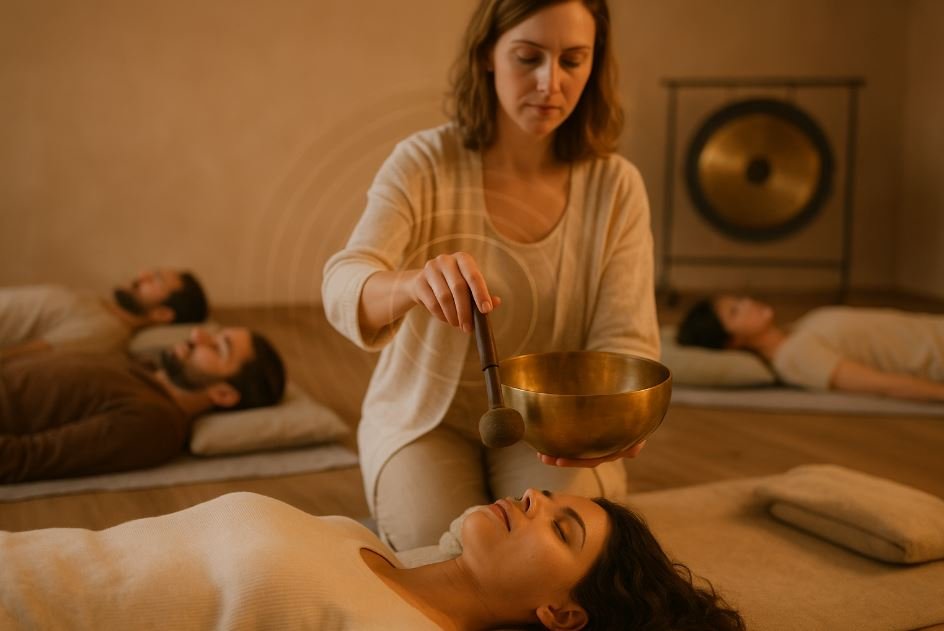
I’ve personally attended sound bowl healing sessions and group sound meditations during my recovery from severe anxiety and PTSD episodes. The experience was nothing short of transformative. The deep resonance of the bowls seemed to reach places within me that words never could. The calm, the clarity, and the sense of grounding that followed were profound and it’s no wonder these ancient practices were preserved and revered for centuries.
A growing body of clinical research shows that music and sound-based interventions can reduce physiological stress markers and improve psychological symptoms.
Modern research is beginning to show that sound and music don’t just influence our mood or brainwaves, they may also affect our biology on a much deeper level. Early studies suggest that listening to or creating music can actually change how certain genes are expressed, influencing processes like brain growth, immunity, and cell repair. In lab experiments, specific sound frequencies even appeared to disrupt cancer cells while leaving healthy ones unharmed.
These results are still preliminary and not used as medical treatments yet, but they reveal something fascinating: vibration and sound can influence how our cells and genes behave. As science continues to explore this field, we may discover that sound has a much greater healing potential, reaching right down to the level of our DNA.
“When scientific research, spiritual practice and artistic expression work together, heaven and earth are in resonance. This is the vibratory promise that is the gift of our musical universe.” — Fabien Maman
Sound healing modalities like singing bowls, gongs, tuning forks, voice, choral singing, and guided sound baths work on several interlocking mechanisms:
(de Witte, 2022) de Witte, M., Spruit, A., van Hooren, S., Moonen, X., & Stams, G.-J. J. M. (2022). Music therapy for stress reduction: a systematic review and meta-analysis. Psychology & Health. (Taylor & Francis Online)
(Hasanah et al., 2020) Hasanah, I., Prihartini, E. S., & Suryadi, S. (2020). Effect of music therapy on cortisol as a stress biomarker in children with leukaemia undergoing IV-line insertion. Journal of Nursing and Health Studies. (example trial reporting cortisol reduction). (PMC)
(Sound Health Initiative / meta-analysis) Sound Health Initiative. (Year). Systematic review and meta-analysis of music therapy on stress outcomes. American Music Therapy Association / related review. (musictherapy.org)
(Lu et al., 2021) Lu, G., et al. (2021). Effects of music therapy on anxiety: A meta-analysis of randomized controlled trials. Journal of Affective Disorders (example meta-analysis). (ScienceDirect)
(Ma et al., 2024) Ma, Y.-M., et al. (2024). Efficacy and acceptability of music therapy for post-traumatic stress disorder: a systematic review and meta-analysis of randomized controlled trials. European Journal of Psychotraumatology, 15(1), 2342739. (PubMed)
(Nair et al., 2020) Nair, P. S., et al. (2020). Music-listening regulates human microRNA expression. Frontiers in Neuroscience. (PMC)
(Gómez-Carballa et al., 2023) Gómez-Carballa, A., et al. (2023). Music compensates for altered gene expression in age-related cognitive decline. Scientific Reports. (Nature)
(Maman & Grimal, 1981; Maman reports) Maman, F., & Grimal, H. (1981). Effects of sound vibration on healthy and malignant human cells. [Unpublished laboratory report]. CNRS, Paris. (Early cell-culture experiments reported in alternative-health literature). (soundtravels.co.uk)
(Valenti, 2024) Valenti, D. (2024). Sound Matrix Shaping of Living Matter. Journal / review article on sound and living cells (review of cell and cymatics research). (PMC)
If you have been living with anxiety, chronic stress, trauma, or physical symptoms that feel stuck, sound healing may help you find coherence, calm, and clarity. Ready to explore how sound healing can be used in your healing? Book an introductory session with Serenova Coaching at Watsapp or Contact Us.
Serenova Coaching copyright ©2026. All rights reserved. The brand, logo, and its content are copyrighted. For more details, please read our Privacy Policy.